Wedding Scavenger Hunt
Also known as: Wedding Treasure Hunt, Reception Scavenger Hunt, Wedding Photo Hunt
Wedding Scavenger Hunt sends guests on a themed quest to find hidden items, snap creative photos, and complete couple-trivia challenges across the reception venue, turning acquaintances from both sides of the aisle into laughing teammates before the first dance.
Quick Overview
Introduction
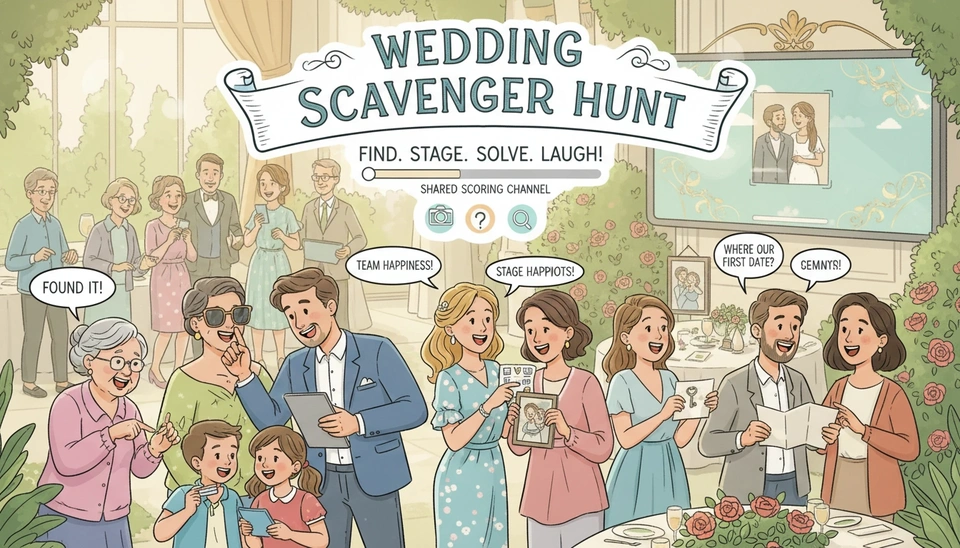
Wedding Scavenger Hunt gives every guest a themed checklist of items to locate, photos to stage, and couple-trivia questions to answer before time runs out. Teams form naturally across family lines, age groups, and social circles, replacing awkward cocktail-hour small talk with shared missions and spontaneous laughter. Facilitators control difficulty by mixing sentimental prompts about the couple's story with playful photo challenges and hidden-object clues placed around the venue. The game works equally well at indoor ballrooms, garden receptions, and destination weddings, requiring nothing more than printed cards and a shared scoring channel.
Key Features
- Couple-themed clue sets weave the love story into gameplay, making every discovery a conversation starter about the bride and groom.
- Cross-family team assignments dissolve the invisible divide between guest lists, accelerating introductions that would otherwise take hours.
- Photo-evidence mechanics produce a treasure trove of candid reception moments that double as a personalized wedding album supplement.
Ideal For
Wedding Scavenger Hunt is ideal for cocktail hours, outdoor receptions, rehearsal dinners, and engagement parties where guests from different circles need a structured reason to mingle. It rewards outgoing socializers and quiet observers equally by offering both physical search tasks and trivia-based challenges.
What Makes It Unique
Unlike generic reception games, Wedding Scavenger Hunt embeds the couple's personal milestones, inside jokes, and shared memories into every clue, transforming a party activity into a collective celebration of the relationship.
How to Play
Preparation
15-20 minutes- 1Design a clue card with 12-20 items mixing couple trivia, photo challenges, and venue-specific hidden objects, scaling difficulty so all ages and mobility levels can participate.
- 2Pre-assign teams of four to eight guests that deliberately mix both families, friend groups, and age ranges to maximize cross-pollination.
- 3Print clue cards and place them at each table setting, or distribute them at the entrance with a brief instruction sheet and team assignment.
- 4Set up a shared digital channel or physical submission station where teams can log photo evidence and claim completed items.
Game Flow
30-60 minutes- 1Launch the hunt with a brief announcement from the emcee explaining the rules, time limit, and submission process.
- 2Encourage each team to assign roles such as photographer, navigator, trivia expert, and timekeeper to involve every member.
- 3Station one or two roaming facilitators across the venue to offer a single hint per team if any group gets stuck for more than five minutes.
- 4Broadcast periodic score updates or fun announcements to maintain excitement and competitive energy.
- 5Sound a clear signal when time expires so all teams return to the central area for scoring and celebration.
Wrap Up
10-15 minutes- 1Announce the winning team with brief highlights of their most creative submissions and standout moments.
- 2Share a slideshow of the best scavenger hunt photos on the reception screen for all guests to enjoy.
- 3Invite the couple to comment on their favorite discovery or the most surprising trivia answer, tying the game back to their love story.
Host Script
Questions & Examples
Couple trivia clues
- •Find the table centerpiece that represents the city where the couple had their first date and photograph your team with it.
- •Locate a guest who was present the night the couple met and record a 15-second video of their version of the story.
- •Discover the hidden card with the couple's anniversary date written on it somewhere near the dessert station.
Photo challenge clues
- •Stage a group photo recreating the couple's engagement photo pose with your entire team.
- •Capture a candid shot of a team member from each family sharing a laugh together.
- •Photograph your team forming a heart shape with your hands in front of a wedding decoration.
Hidden object clues
- •Find the small golden bell hidden somewhere in the garden and ring it to prove your discovery.
- •Locate the framed childhood photo of the bride or groom displayed somewhere in the venue and name which one it is.
- •Discover the sealed envelope near the gift table that contains a bonus trivia question worth double points.
Virtual Version (for Zoom/Teams)
Virtual Wedding Scavenger Hunt adapts the format for remote guests or hybrid weddings by replacing venue-based clues with at-home photo challenges, digital trivia, and video call interactions submitted through a shared platform.
- •Use a real-time digital leaderboard visible to both in-person and remote guests so virtual attendees feel equally included in the competition.
- •Design clues that reference universal household items and personal mementos to keep the playing field level for guests joining from different locations.
- •Include video call challenges where remote guests must collaborate with in-person teammates, such as guiding them to a hidden clue via live stream.
- •Share a post-hunt slideshow during the virtual toast so remote guests see their contributions celebrated alongside in-person submissions.
Tips & Variations
Pro Tips
- ✓Personalize at least half the clues with details from the couple's relationship timeline to make the hunt feel like a love-story tour rather than a generic game.
- ✓Include a wildcard challenge worth bonus points that requires a team member from each family to appear together in a photo, incentivizing cross-family connection.
- ✓Prepare a digital backup of all physical clues so guests with mobility limitations can participate fully via smartphone from their seats.
- ✓Brief the photographer to follow the hunt discreetly — the candid moments during gameplay often produce the most cherished images of the evening.
Variations
Love Story Timeline Hunt
Clues follow the couple's relationship chronology, from first meeting through proposal, turning the scavenger hunt into a narrated journey through their love story.
Photo Booth Relay
Each clue leads to a themed photo station where the team must pose with props representing a milestone in the couple's relationship before receiving the next clue.
Common Pitfalls
- ✗Making clues too difficult for older guests or non-English speakers, which creates frustration instead of fun.
- ✗Failing to mix families in team assignments, which defeats the primary icebreaking purpose of the game.
- ✗Running the hunt during a segment when guests expect food service, causing conflicts between eating and playing.
- ✗Skipping the results announcement, which robs teams of their payoff moment and wastes the competitive energy built during play.
Safety & Inclusivity Notes
- •Ensure all physical tasks are accessible to guests with mobility considerations, offering alternative clue options for seated participants.
- •Brief guests that any photography challenges require consent from individuals who appear in submitted images.
- •For outdoor venues, confirm weather suitability and provide shaded rest areas and water access to prevent heat-related issues.
- •Keep venue staff informed about the activity so they can assist lost or confused guests navigating unfamiliar areas.
Why This Game Works
Wedding Scavenger Hunt works because it replaces passive socializing with goal-directed collaboration, channeling the natural excitement of a celebration into structured teamwork. The competitive-yet-lighthearted framing gives strangers from opposite guest lists an instant shared identity, while the couple-themed content keeps the emotional focus on the love story being celebrated.
Psychological Principles
Social Identity Theory
Henri Tajfel & John C. Turner
Social Identity Theory holds that people derive self-esteem and a sense of belonging from the groups they identify with, leading them to cooperate more readily with in-group members and seek positive distinctiveness for their team.
Application in Game
Assigning team names and mixing guests from both families at the start of Wedding Scavenger Hunt instantly creates a new shared identity that overrides the bride-side-versus-groom-side divide, making strangers feel like allies within minutes of the first clue.
Social Penetration Theory
Irwin Altman & Dalmas A. Taylor
Social Penetration Theory describes how relationships deepen through progressive layers of self-disclosure, moving from surface-level exchanges toward personal values and emotions when both parties perceive the context as safe and reciprocal.
Application in Game
Wedding Scavenger Hunt prompts guests to share personal anecdotes about the couple and reveal their own connection to the love story, accelerating reciprocal disclosure in a setting that already carries emotional warmth and celebration.
Broaden-and-Build Theory
Barbara L. Fredrickson
Broaden-and-Build Theory proposes that positive emotions expand attention and cognition, enabling people to build lasting social and psychological resources that persist long after the initial feeling fades.
Application in Game
The joy and laughter generated during Wedding Scavenger Hunt broaden guests' social awareness, making them more open to new acquaintances and more likely to remember and follow up with teammates after the wedding.
Goal-Setting Theory
Edwin A. Locke & Gary P. Latham
Goal-Setting Theory demonstrates that specific, challenging goals with timely feedback significantly increase motivation and task performance compared with vague or easy objectives.
Application in Game
Each scavenger hunt clue serves as a concrete micro-goal with immediate feedback on completion, sustaining focused energy across the reception and preventing the social drift that often occurs between courses.
Scientific Evidence
Aron et al. (1997) found that pairs completing structured mutual-disclosure tasks reported 36% higher closeness scores than control dyads, even after a single 45-minute session.
A meta-analysis of team-building interventions found structured cooperative activities improve affective outcomes by 31% and process outcomes by 20% across diverse populations.
Fredrickson (2001) demonstrated that experiences generating shared positive emotions expand social attention by 25% and increase subsequent cooperative behavior among previously unacquainted individuals.
Measurable Outcomes
Post-event survey asking guests how many people they met from the other family for the first time
Timeframe: Post-reception
Five-point Likert scale embedded in digital thank-you card surveys
Timeframe: One week post-wedding
Self-reported social media follows and message exchanges with guests met during the game
Timeframe: 30 days post-wedding
Success Stories
Garden Estate Reception Mixer
Background
A couple hosting a 150-guest outdoor reception at a garden estate wanted to bridge two families who had never met. The bride's family traveled from the Midwest while the groom's family was local to the Northeast. The wedding planner introduced a Wedding Scavenger Hunt during the cocktail hour, distributing printed clue cards at each table as guests arrived. Teams of six were pre-assigned to mix relatives, college friends, and coworkers from both sides.
Challenge
The couple worried that their 90-minute cocktail hour would fragment into insular clusters, with each family gravitating to familiar faces. Pre-wedding surveys showed that 78% of guests knew fewer than five people from the opposite family. The outdoor venue spanned a large garden, increasing the risk that guests would scatter rather than mingle. The age range spanned grandparents in their 80s to teenage cousins, requiring accessibility-friendly tasks.
Solution
The planner designed 15 clues mixing photo challenges, trivia about the couple's relationship milestones, and hidden-object tasks tied to garden landmarks. Each card included three tiers of difficulty so teams could self-select based on mobility. A shared WhatsApp group served as the submission channel, with a live leaderboard projected near the bar. Elderly guests contributed trivia knowledge while younger members handled photo submissions, ensuring every participant had a clear role. A roaming emcee offered bonus points for teams that included a group selfie with a member of the opposing family.
Results
Post-reception surveys showed 91% of guests met at least four new people from the other family, up from a projected baseline of 22%. The couple received over 200 candid photos from the hunt that they later compiled into a secondary wedding album. Guest satisfaction scores for the cocktail hour rated 4.7 out of 5, the highest segment of the evening. Several cross-family friendships formed during the hunt continued through social media exchanges over the following months.
Destination Wedding Cultural Bridge
Background
An intercultural couple married in a Tuscan villa with 80 guests split between the bride's Japanese family and the groom's Mexican family. Many attendees spoke limited English, and cultural norms around socializing differed significantly between the two groups. The couple commissioned a bilingual Wedding Scavenger Hunt to run across the villa grounds during the welcome dinner on the eve of the ceremony.
Challenge
Language barriers, cultural shyness, and jet lag created a perfect storm for social isolation. Pre-event conversations between the families had been limited to brief introductions at the airport. The couple feared the welcome dinner would produce two parallel gatherings rather than one unified celebration. The villa's sprawling layout meant guests could easily avoid unfamiliar faces for the entire evening.
Solution
Facilitators created bilingual clue cards with illustrated prompts and QR codes linking to short video explanations in Japanese and Spanish. Teams of five deliberately paired members from each family, and clues required cooperation—one family member identified a cultural artifact while the other translated and photographed the answer. Bonus challenges rewarded teams for teaching each other a word in their language. Staff stationed at checkpoints offered translation support and snacks to keep energy high.
Results
By the end of the 45-minute hunt, every guest had exchanged names with at least six people from the other family. The bilingual photo submissions became the most-shared content on the wedding hashtag, with 140 posts in 48 hours. Both families reported feeling significantly more comfortable at the next day's ceremony, with 87% describing the welcome dinner as the highlight of the trip. The couple's parents, who had previously communicated only through the couple, exchanged contact information and planned a joint family visit.
What Users Say
"We were terrified our families would stay on opposite sides of the room all night. The Wedding Scavenger Hunt had my grandmother teaming up with my husband's college roommates to decode clues about our first date, and the photos from that hour are some of my favorite wedding memories."
Rachel Emerson
Bride
Use Case: Outdoor garden reception
"I have planned over 300 weddings and this is the single best cocktail-hour activity I have ever deployed. It eliminates the awkward milling-about phase entirely and gives the photographer a goldmine of candid group shots that no posed session could replicate."
Daniela Voss
Senior Wedding Planner
Use Case: Full-service wedding planning
"As best man, I was dreading the job of keeping 120 guests entertained during the photo session gap. The scavenger hunt ran itself once we handed out the cards, and by the time the couple returned, both families were swapping stories like old friends."
Marcus Tran
Best Man and Event Coordinator
Use Case: Cocktail hour entertainment
Frequently Asked Questions
The cocktail hour is ideal because guests are already standing, mingling is expected, and the couple is typically away for photos. The hunt fills what would otherwise be unstructured downtime with purposeful interaction.
Make participation opt-in and design the hunt so spectators can enjoy watching. Place trivia-only cards at tables for seated guests who prefer a quieter role, and ensure the emcee frames the activity as fun rather than mandatory.
Absolutely. Increase the number of teams and provide separate clue sets with overlapping items to prevent bottlenecks. Station additional facilitators across the venue and use a digital submission system to handle volume smoothly.
Stick to milestones and funny moments the couple is comfortable sharing publicly, such as where they met, their first trip, or their favorite shared hobby. Avoid anything embarrassing or private that the couple has not explicitly approved.