Photo Scavenger Hunt
Also known as: Photo Challenge, Picture Scavenger Hunt, Snap Hunt
Photo Scavenger Hunt sends teams racing to capture creative photos that match themed prompts, turning any venue into a collaborative storytelling playground. Players huddle in small squads, negotiate poses, scout unexpected angles, and narrate their shots before a timed gallery walk where every team presents its favorites. Facilitators score entries on creativity, teamwork, and relevance, then debrief the stories behind each image to surface hidden talents, shared humor, and cross-functional rapport that carries into subsequent meetings and projects.
Quick Overview
Introduction
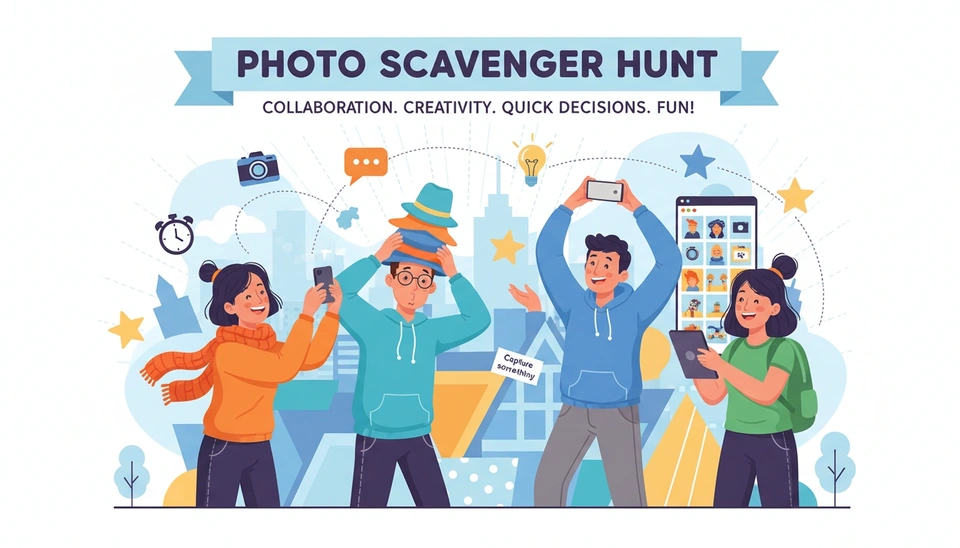
Photo Scavenger Hunt gives every team a shared mission that demands collaboration, creativity, and quick decision-making under a friendly time constraint. Each prompt forces players to negotiate ideas, assign roles, and celebrate quirky solutions, generating natural conversation that skips small talk entirely. Facilitators collect the photos into a live gallery, turning the debrief into a storytelling session where teams explain their creative choices and discover unexpected common ground.
Key Features
- Prompt lists blend work-relevant themes with playful challenges, ensuring every photo sparks a story that connects professional skills to personal creativity.
- Small-team format guarantees that quieter participants contribute ideas while extroverts channel energy into coordination rather than domination.
- A timed gallery walk with peer voting turns the debrief into a celebration, reinforcing shared identity and giving facilitators rich material for follow-up pairing.
Ideal For
Perfect for retreat kickoffs, cross-functional mixers, onboarding days, or conference socials where teams need a high-energy activity that produces shareable artifacts and lasting inside jokes.
What Makes It Unique
Photo Scavenger Hunt creates a permanent visual record of team chemistry, giving leaders a gallery of authentic moments that double as culture artifacts for newsletters, retrospectives, and future onboarding decks.
How to Play
Preparation
5 minutes- 1Design a themed prompt list with 12-20 photo challenges covering a mix of creative, strategic, and playful categories.
- 2Set up a shared digital album or projection screen where teams will upload their photos in real time.
- 3Divide participants into cross-functional teams of 4-6 and distribute prompt cards, timers, and any accessibility materials.
Game Flow
20-30 minutes- 1Kick off with a sample photo challenge demonstrated by the facilitator to show the expected creativity and caption style.
- 2Release teams to explore the venue, capturing photos that match each prompt on their list.
- 3Use timer announcements at the halfway mark and five-minute warning to maintain urgency and encourage prioritization.
- 4Encourage teams to rotate the photographer role so every member directs at least one composition.
- 5Announce optional bonus challenges midway through to sustain energy and reward risk-taking.
Wrap Up
5-10 minutes- 1Gather everyone for a gallery walk where each team presents their top three photos and explains the story behind each.
- 2Run a quick peer vote on categories like Most Creative, Best Storytelling, and Funniest Moment.
- 3Debrief by connecting themes from the photos to upcoming work, then invite teams to share their album links and follow-up commitments.
Host Script
Questions & Examples
Team identity
- •Stage a group photo that represents your team's superpower
- •Capture your team's reaction to an imaginary plot twist
- •Photograph a human sculpture of your team's motto
Venue exploration
- •Find the most photogenic hidden corner of the building
- •Photograph something that no one notices on a normal day
- •Capture a creative use of natural light or shadows
Work themes
- •Recreate a famous product launch moment as a freeze-frame
- •Stage a scene showing your ideal customer experience
- •Photograph something that represents innovation to your team
Playful challenges
- •Create a dramatic movie poster using only your team members
- •Photograph the most creative use of an everyday object
- •Capture a perfectly timed action shot of your team in motion
Virtual Version (for Zoom/Teams)
Photo Scavenger Hunt adapts to virtual settings when prompts shift to home environments and collaborative platforms handle submissions and voting.
- •Send prompt lists in advance so remote participants can scout their home or neighborhood for creative photo opportunities.
- •Use a shared whiteboard or slide deck where teams upload photos in real time and add captions collaboratively.
- •Create breakout rooms for team strategizing and return to the main room for the gallery walk and voting ceremony.
- •Allow participants to submit short video clips as alternatives to photos for prompts that benefit from motion or narration.
Tips & Variations
Pro Tips
- ✓Seed 30% of prompts with current strategic themes so photo conversations reinforce mission-critical priorities.
- ✓Brief team ambassadors to ensure quieter members get camera time and idea-directing opportunities.
- ✓Collect all photos into a permanent gallery that can be repurposed for newsletters, onboarding decks, and retrospectives.
- ✓Add a mid-hunt member swap where one person rotates to another team, cross-pollinating energy and ideas.
Variations
Story Arc Hunt
Structure prompts as beginning, middle, and end scenes so each team produces a visual narrative they present as a mini-film.
Brand Challenge Hunt
Replace general prompts with brand or product-themed challenges where teams visualize company values, customer personas, or campaign concepts.
Mystery Location Hunt
Reveal prompts one at a time via a chatbot or app, adding a puzzle-solving layer as teams decode clues to find their next photo location.
Common Pitfalls
- ✗Making prompts too literal, which kills creativity and produces identical photos across teams.
- ✗Skipping the gallery walk and debrief, missing the storytelling that converts fun into lasting connections.
- ✗Allowing one team member to dominate the camera, which sidelines quieter participants from the creative process.
- ✗Setting too many prompts for the allotted time, creating stress instead of playful urgency.
Safety & Inclusivity Notes
- •Confirm that all participants consent to being photographed and clarify how images will be used or shared.
- •Include prompts with indoor alternatives so participants with mobility limitations can fully participate.
- •Remind teams to respect private spaces, other people's boundaries, and venue-specific photography rules.
- •Offer an opt-out role such as creative director or caption writer for anyone uncomfortable appearing in photos.
Why This Game Works
Photo Scavenger Hunt works because it channels competitive energy into cooperative creativity, giving every participant a defined role in a time-bound mission. Neuroscience research shows that shared goal pursuit under moderate pressure triggers dopamine release, reinforcing social bonds and making the experience memorable. At the same time, the visual and kinesthetic nature of the task lowers the barrier to contribution for participants who struggle with purely verbal icebreakers. The act of composing a photo together requires negotiation, spatial awareness, and humor, all of which accelerate trust formation without demanding vulnerable self-disclosure.
Psychological Principles
Social Penetration Theory
Irwin Altman & Dalmas A. Taylor
Social Penetration Theory describes how relationships deepen through gradual layers of self-disclosure, moving from superficial facts toward personal values and emotions. Altman and Taylor emphasize that reciprocity and shared experiences determine whether people feel safe enough to reveal more about themselves.
Application in Game
In Photo Scavenger Hunt, creative prompts invite teams to express preferences, humor, and problem-solving styles without requiring direct personal disclosure. Staging a photo together is an act of mutual vulnerability that mirrors structured self-disclosure, because each member contributes ideas and accepts the group's creative direction. The gallery walk then extends this progression as teams narrate their choices, layering personal meaning onto a shared artifact.
Cognitive Load Theory
John Sweller
Cognitive Load Theory posits that learning and social processing improve when extraneous cognitive demands are minimized. Sweller's research demonstrates that well-structured tasks free working memory for meaningful engagement rather than anxious self-monitoring.
Application in Game
Photo Scavenger Hunt reduces the cognitive burden of networking by replacing open-ended introductions with concrete missions. Players focus on solving visual puzzles together rather than worrying about what to say, allowing authentic interaction to emerge naturally. The prompt list acts as external scaffolding that channels mental effort toward creativity instead of social anxiety.
Psychological Safety
Amy C. Edmondson
Psychological safety describes a shared belief that the team is safe for interpersonal risk taking, enabling members to propose unconventional ideas without fear of ridicule. Edmondson demonstrated that psychologically safe teams innovate faster because members share more candid input.
Application in Game
Photo Scavenger Hunt builds psychological safety by framing every contribution as creative input toward a team goal rather than individual performance. Silly prompts normalize playfulness and signal that imperfection is welcome. When facilitators celebrate the most inventive rather than the most polished photos, they reinforce that risk-taking is rewarded, a mindset that carries into subsequent collaborative work.
Self-Determination Theory
Edward L. Deci & Richard M. Ryan
Self-Determination Theory posits that motivation strengthens when three basic psychological needs—autonomy, competence, and relatedness—are satisfied. Deci and Ryan show that environments supporting these needs stimulate intrinsic motivation, leading to sustained engagement even without external rewards.
Application in Game
Photo Scavenger Hunt satisfies autonomy by letting teams choose how to interpret each prompt, competence by producing a tangible creative artifact, and relatedness by requiring coordination and shared celebration. When facilitators invite teams to design bonus prompts or vote on categories, the activity deepens intrinsic motivation and fosters ownership that extends into future team rituals.
Scientific Evidence
Aron et al. (1997) found that pairs completing structured shared activities reported 36% higher closeness scores than control dyads on the Inclusion of Other in the Self scale.
Csikszentmihalyi (1990) demonstrated that group activities combining clear goals, immediate feedback, and matched challenge-skill balance produce flow states that enhance both enjoyment and interpersonal bonding.
Salas et al. (2008) reported that team training interventions produced a 20% performance improvement and 31% affective gain across 60 samples, with hands-on collaborative tasks showing the strongest effects.
Measurable Outcomes
Measured with the Group Environment Questionnaire immediately after Photo Scavenger Hunt.
Timeframe: Post-activity
Counted via post-event surveys comparing new connections made versus prior mixer baselines.
Timeframe: One week follow-up
Tracked through pulse surveys asking for weekly instances of cross-functional idea sharing.
Timeframe: Thirty days
Success Stories
E-Commerce Platform Offsite Kickoff
Background
A 120-person e-commerce company gathered its product, engineering, and marketing teams at a lakeside resort for a three-day strategic planning offsite. Many remote employees had never met in person, and leadership wanted to dissolve departmental silos before the sprint sessions began. The events team selected Photo Scavenger Hunt to open the first morning because it required movement, creativity, and cross-functional collaboration. Prompt lists blended brand storytelling challenges with nature-inspired compositions, requiring teams of five to scout the resort grounds and produce twelve photos in twenty-five minutes. Each team received a shared album link, and facilitators projected submissions onto a poolside screen for live voting. The mix of indoor and outdoor prompts ensured accessibility for participants with mobility considerations, while optional bonus rounds rewarded teams that incorporated company values into their compositions.
Challenge
Before the offsite, engagement surveys showed that 61% of remote employees could not name a colleague outside their immediate squad, and cross-functional Slack channels averaged fewer than three messages per week. Previous retreat openers relied on panel discussions that produced passive attendance and minimal networking. Product managers complained that engineers rarely understood customer context, while marketers felt excluded from roadmap conversations. Leadership worried that starting sprint sessions without rapport would repeat the pattern of cautious, low-energy brainstorming that had stalled the last two product launches.
Solution
Facilitators divided participants into mixed-department teams of five using a randomized badge system. Each team received a themed prompt card with twelve challenges ranging from 'recreate your favorite product feature as a human sculpture' to 'capture the team's vision for Q3 in a single landscape.' Teams had twenty-five minutes to photograph as many prompts as possible, uploading each shot to a shared album with a one-sentence caption. Roaming facilitators offered creative nudges and ensured quieter members held the camera or directed compositions. After the hunt, all photos streamed onto a projection screen for a five-minute gallery walk where teams narrated their top three shots and the audience voted on categories like Most Creative, Best Storytelling, and Funniest Outtake.
Results
Post-offsite surveys showed 89% of participants could name at least three colleagues from different departments, up from 39% baseline. Sprint session facilitators reported a 44% increase in unsolicited idea contributions during the first afternoon compared with the previous offsite. The shared photo album accumulated 340 images and became the company's most-viewed Slack channel for six weeks. Three product concepts pitched during the offsite traced their origin to conversations that started during the Photo Scavenger Hunt, and the VP of Product credited the activity with normalizing creative risk-taking across the organization.
University Orientation Week Energizer
Background
A large public university redesigned its first-year orientation week to include a Photo Scavenger Hunt across campus, replacing the traditional campus tour with an interactive exploration. Orientation leaders organized 400 incoming freshmen into teams of eight, each guided by a returning student ambassador. Prompts directed teams to photograph campus landmarks, hidden study spots, wellness resources, and cultural centers while capturing creative group poses that expressed team identity. The student affairs office wanted incoming students to learn campus geography, meet peers from different majors, and build confidence approaching campus services before classes began. Digital submissions fed into a live leaderboard displayed on the student union's outdoor screen.
Challenge
Prior orientation formats relied on walking tours led by single guides, which produced passive groups and minimal peer interaction. Surveys from the previous year showed that 47% of freshmen still felt lost on campus after orientation week, and only 23% reported making a friend outside their residence hall. Commuter students and international arrivals reported feeling especially disconnected because they lacked the organic dorm-room bonding that residential students experienced. Student affairs leaders needed an activity that combined wayfinding with social bonding at scale.
Solution
Facilitators designed forty prompts organized into four campus zones: academic core, wellness and recreation, cultural and arts district, and hidden gems. Each prompt required a creative photo and a brief caption explaining what the team learned. Accessibility-friendly alternatives let teams complete indoor equivalents for any outdoor prompt. Ambassadors carried tip cards with conversation starters to keep dialogue flowing between photo stops. A midpoint checkpoint at the student union offered water, snacks, and a bonus challenge where teams swapped one member with another team to cross-pollinate connections. The hunt ran for forty-five minutes followed by a fifteen-minute awards ceremony with prizes for navigation accuracy, creativity, and team spirit.
Results
Post-orientation surveys showed 82% of participants could navigate to five or more campus services independently, compared with 53% the previous year. Freshmen who participated in Photo Scavenger Hunt reported 56% more peer connections in their first week. Commuter students rated the experience 4.6 out of 5, citing the team structure as the reason they felt included. The photo gallery generated 1,200 submissions and became a featured section of the university's social media welcome campaign, reaching 45,000 impressions. Residence advisors noted that Photo Scavenger Hunt teams continued meeting informally during the first month, forming study groups and intramural sports rosters.
Healthcare Innovation Summit Connector
Background
A regional hospital network convened 50 clinical innovators, administrators, and patient advocates for a two-day summit on improving outpatient experience. Attendees represented eight facilities spread across four states, and many had only interacted through video calls about compliance issues. The summit director chose Photo Scavenger Hunt to open the afternoon because it would get people moving through the conference center and force cross-facility teams to collaborate on creative interpretations of patient journey themes. Prompts referenced real workflow pain points, patient feedback quotes, and wellness design principles, ensuring every photo connected to the summit's strategic goals. Infection-control-friendly materials included individual stylus pens and sanitized tablets for teams that preferred not to use personal phones.
Challenge
Previous summits opened with keynote panels that left attendees seated for ninety minutes, producing low energy and minimal cross-facility networking. Post-event surveys showed that only 31% of participants initiated a conversation with someone from a different hospital during the entire event. Administrators and clinicians operated in separate spheres, with administrators focused on throughput metrics and clinicians prioritizing bedside care quality. Patient advocates felt their perspectives were treated as add-ons rather than integral contributions. The summit director needed a reset that would mix roles, energize the room, and generate artifacts that fed directly into the afternoon design workshops.
Solution
Facilitators created teams of five mixing clinicians, administrators, and patient advocates from different facilities. Each team received a tablet with fifteen prompts such as 'photograph something that represents unnecessary patient waiting' and 'stage a scene showing your ideal discharge experience.' Teams had twenty minutes to capture photos throughout the conference center and adjacent courtyard. Optional audio captions let teams record thirty-second voice notes explaining their creative rationale. After the hunt, facilitators projected a curated selection and invited each team to present their most impactful image. Voting categories included Most Insightful, Best Patient Perspective, and Most Actionable Idea. The winning photos were printed and mounted on the design workshop walls as inspiration anchors.
Results
Post-hunt energy surveys scored 4.7 out of 5, compared with 3.1 for the prior year's keynote opener. During the subsequent design workshop, facilitators observed a 39% increase in cross-role contributions, with patient advocates proposing three of the five finalist improvement concepts. Follow-up interviews revealed that 88% of participants had exchanged contact information with at least two people from different facilities, and 67% scheduled follow-up calls within two weeks. The Photo Scavenger Hunt gallery became a recurring reference in the network's monthly innovation newsletter, and two facilities adopted the format for their own quarterly team meetings.
What Users Say
"Photo Scavenger Hunt broke through the awkwardness of our first in-person gathering in two years. Engineers who had only been Slack handles suddenly became creative partners, and the shared album became our team's most treasured artifact. We still reference those photos in retros months later."
Danielle Cho
VP of Product
Use Case: Annual company offsite
"Our freshmen went from strangers to study partners in forty-five minutes. The scavenger hunt taught them campus navigation and gave them a shared experience to bond over. Commuter students told us it was the first time they felt like they belonged on campus."
Marcus Okafor
Director of New Student Programs
Use Case: Freshman orientation week
"We needed clinicians and administrators to stop talking past each other, and Photo Scavenger Hunt made that happen in twenty minutes. Staging patient journey scenes together forced empathy in a way that slide decks never could. Three real improvement projects came directly from hunt photos."
Dr. Amara Osei
Chief Innovation Officer
Use Case: Healthcare innovation summit
Frequently Asked Questions
Aim for 12 to 20 prompts for a 20- to 30-minute session. This gives teams enough variety to be selective and creative without feeling rushed. Include a mix of easy warm-up prompts and ambitious stretch challenges.
Assign alternative roles like creative director, caption writer, or scout so every participant contributes meaningfully without appearing on camera. State this option clearly at the start to normalize opting out.
Absolutely. Shift prompts to home or neighborhood settings, use a shared digital album for submissions, and run the gallery walk over video conference. The creative constraint of working within personal spaces often produces the most inventive results.
Use fun, non-hierarchical voting categories like Most Creative Angle, Best Caption, and Funniest Outtake so multiple teams win. Frame the gallery walk as a celebration rather than a competition.